
How to become an independent language tutor
What changes when you teach on your own terms — owning your pricing, building a profile that sells, taking payment directly, and finding your first students.
The MyChamba Team · Published 14 September 2026 · 12 min read
What "independent" actually means
Independent does not mean full-time, and it does not mean exclusive. It means one thing: you own the channel. Students find you through something that belongs to you, they agree a price with you, they pay you, and if anything else in the market changes, the relationship survives it. Plenty of tutors run an independent practice alongside other work for years and never make it their only source of students, and for most people that is the sensible shape.
What changes in practice is that four jobs become visibly yours: finding students; agreeing terms, including the awkward ones about cancellations and late payment; collecting the money and keeping the records; and the admin behind all of it — who has paid for what, who is due a class, what you taught last week.
None of those are hard. They are simply unpaid, and they were invisible when somebody else was doing them, which is why almost every new independent tutor underestimates the hours.
What you get in return is control and resilience. You set the price, you set the hours, you choose who you work with, and you keep the relationship when circumstances change. That last one is the argument that matters most and gets mentioned least: anything that can send you students can also stop sending you students, for reasons that have nothing to do with how well you teach. A channel of your own is the only part of your income you can actually protect.
Before anything else: read your current platform's terms
If you currently teach through a tutoring platform or marketplace, start by reading its terms of service properly — the document itself, not a summary someone posted in a forum. Many tutoring platforms restrict contacting or teaching your students off-platform, and the restrictions differ enormously: some are narrow and time-limited, some are broad, some apply only to students the platform introduced to you, some barely address it. You cannot know which you are dealing with without reading it.
Whether and how you go independent is a matter between you and whichever platform you currently use. Nobody on the internet can make that call for you, and this article is not legal advice. If the wording is unclear, ask the platform directly or take proper advice in your own country before you act on an assumption.
The good news is that the clean route does not require you to break anything or to leave anywhere. You can build a channel of your own from scratch — your own profile, your own network, your own booking link — and let it grow alongside whatever you already do. Many established tutors openly list their profiles on several platforms from their own page, because a visitor who can go and read your reviews somewhere they already trust is a visitor who books. Independence built this way adds a route in; it does not close one.
Pricing your own work
The first instinct is to charge roughly what you were getting before, and it is the wrong starting point, because the two numbers are not comparable. What a student paid and what reached you were different figures.
You are also now carrying costs that used to sit somewhere else: finding the student, answering their questions before they book, handling the payment, absorbing the no-show, keeping the records. Independent rates are higher than platform take-home rates for structural reasons, not out of greed.
Build the number from your own side instead. Decide what you need to earn in a month. Divide it by the hours you can realistically teach in that month — and be strict, because a taught hour costs you closer to ninety minutes once prep, notes and messages are counted, and because nobody books every slot. Whatever comes out is your floor. If it looks uncomfortably high next to what you see advertised, that tells you how much unpaid work is hidden in the alternative, not that you are overpriced.
Then resist the urge to undercut yourself for safety. A student choosing an independent tutor is not running a price comparison across a thousand listings; they are choosing a person who was recommended, or whose video they liked, or who clearly works with people like them. Continuity, feedback between lessons, materials made for them and one person who remembers their whole history are worth real money — and they are exactly what you now provide.
Finally, publish the number. Tutors hide their prices hoping to have the conversation later, and it costs them twice: the people who would happily have paid never get to find out, and the people who do enquire arrive expecting to negotiate. A price on the page filters for you, before either of you has spent any time. If you offer a package rate or a short introductory class, put those on the page too, and let the page do the work you would otherwise do by message.
Build a public profile that does the selling
Once you are independent, the thing that persuades people is not you — it is your profile page, working at three in the morning while somebody in another time zone decides whether to learn Spanish this year. It needs to answer four questions fast: who are you, what do you teach, who do you teach it to, and what happens next. Most tutor profiles answer the first two and stop. Here is one that answers all four:
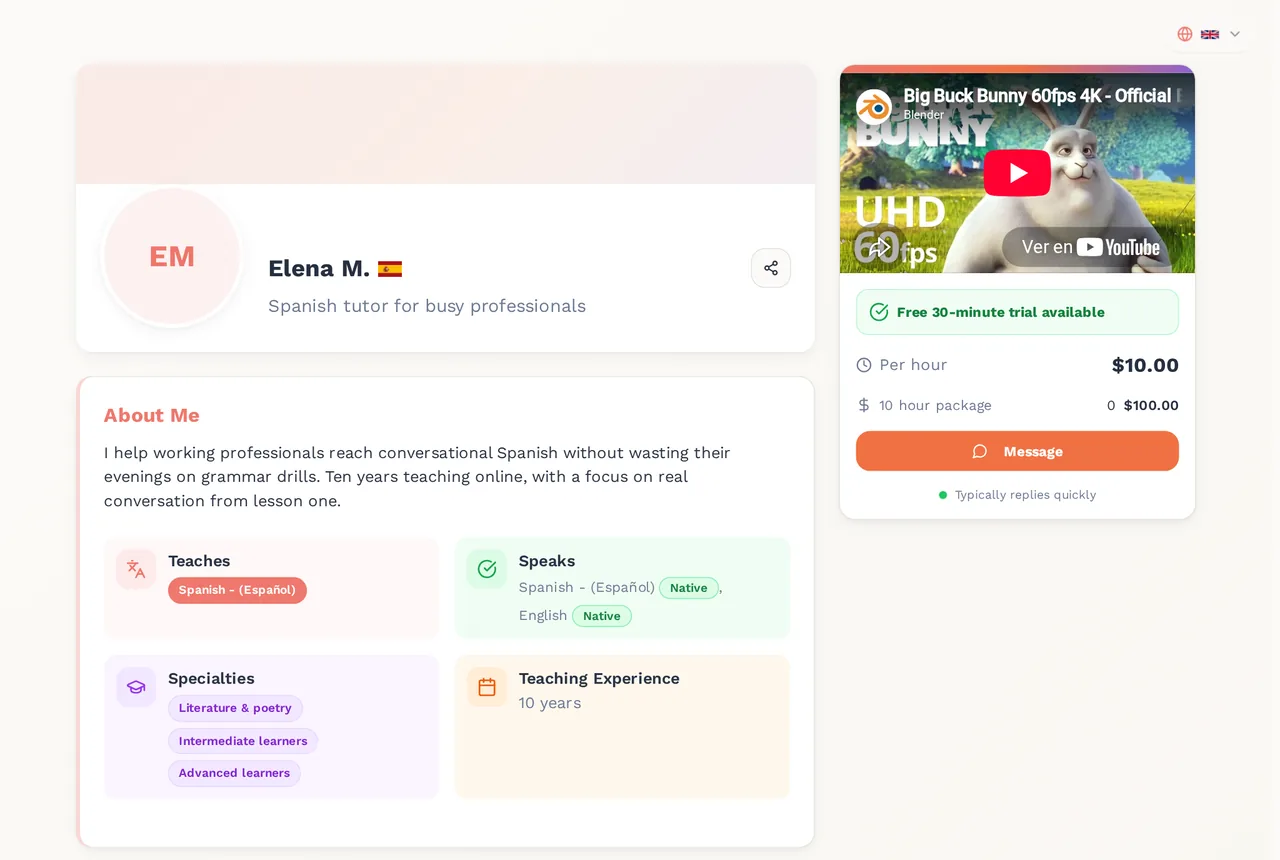
It does not have to be long. A photo, a headline, a few lines about who you help, the languages you teach and speak, your price and — if you offer one — a free first class is enough for a stranger to decide. What sinks a profile is not brevity; it is vagueness.
So be specific where everyone else is general. "Experienced, friendly and patient" describes every tutor who has ever existed and persuades nobody. "I get professionals from B1 to B2 so they can hold meetings in Spanish, usually in about six months" tells a reader whether they are in the right place, which is the only thing they are actually trying to work out. Name the exam, the industry, the level, the situation. The narrower it reads, the more people recognise themselves in it.
Add a short introduction video if you possibly can. For a language tutor it is the single highest-leverage thing on the page, because a student is not choosing a CV — they are choosing a voice, a pace and a manner they will spend an hour a week with. Thirty to sixty seconds, filmed on a phone, is enough. A slightly imperfect video beats a perfect paragraph, and it beats no video by an enormous margin.
Then make the next step obvious and singular. One link, one action: see when I am free, pick a slot. Every step between "I like the look of this person" and "I have a lesson on Thursday" loses people, and the most expensive is "send me a message and we will find a time" — which quietly asks a shy stranger to compose an email in a language they do not yet speak.
Building a presence people can find
- Pick one place and actually use it. Instagram suits language tutors because the work is visual and audible — reels, stories and a bio people can tap — but one account you post to every week beats three you abandoned in March. If you have only ever had a personal account, Instagram's own guide for business accounts is a sane place to start.
- Put your profile link in every bio you have. That is what the link is for: somebody watches thirty seconds of you explaining a preposition, taps your name, and lands on a page that says what you teach, what it costs and how to begin. Nothing you post will rescue a bio with nowhere to go.
- Post the teaching, not the advertising. The most reliable format is the thing you already do for free in lessons: one mistake almost every learner makes, one expression that has no clean translation, one sixty-second explanation of something textbooks handle badly. Two or three a week is plenty, and it compounds.
- Let your personality show. A student is choosing an hour a week with a person, so the accounts that convert are the ones where you can already hear the voice, the pace and the sense of humour. Polished and anonymous loses to slightly rough and recognisable, every time.
- Be findable by the words people actually search. Say the language, the level and who you help, in your bio and in your captions — "Spanish for healthcare workers, B1 to C1" finds more of the right people than "passionate language lover". The line that makes your profile specific is the same line that makes it searchable.
- Play the long game and count the right thing. Content does the one job an advert cannot: it lets a stranger feel what an hour with you is like before they risk any money. That is slow, and followers are not students — the numbers worth watching are enquiries and first lessons. Trust is the product you are actually selling.
Taking payment directly
- Decide four things once — what a lesson costs, when it is paid for, how the money reaches you, and where you write it down — and say the first three in the message where you confirm the first class. Taking money yourself sounds like the frightening part and turns out to be the simplest; almost every awkward conversation you were dreading never happens.
- Get paid before you teach. Blocks of hours — five to start, ten once somebody is settled — mean one transaction instead of twelve, money in advance, and a student who has committed to a stretch of learning rather than to next Thursday.
- Make the first class the sensible exception. A free half-hour taster or a paid short introductory lesson both work well. What does not work is a long unpaid trial, which mostly attracts people who were never going to book.
- Offer payment methods that actually work where your students live, and give each one a link or the exact details. Cross-border payments are the hidden friction of independent tutoring: a method that is normal in your country can be unavailable or expensive in theirs, and a student who has to work out how to pay will put it off. Ask them what is easy on their side — a thirty-second question that prevents a fortnight of "I'll do it this weekend".
- Keep your own records from the first lesson, not from the moment it becomes a problem: hours bought against hours taught for each student, every payment with the date it covers, every class you actually gave. You are running a small business now, in whatever form your country recognises, and the difference between a calm tax return and a bad January is what you wrote down in month one.
Finding your first students, and surviving the first three months
Almost nobody's first independent students are strangers. They are people who already know you exist: former colleagues, friends of friends, people from the community group or the church or the running club, parents at your children's school, the person who asked you two years ago whether you gave private lessons. Make a list of everyone you could tell without embarrassment. It is usually longer than it feels, and it converts better than any advertising ever will.
Then tell them something specific. "I'm taking on students" invites a polite nod. "I'm taking on three people who want to get to conversational Portuguese before the summer, evenings, online" invites somebody to think of a name. Specific requests are forwardable; general ones are not. Say it once, clearly, in the places where people who like you already are, and give them a link rather than asking them to remember your email address.
After that, go where your students already gather rather than where tutors advertise. Immigrant and expatriate associations, language exchange meetups, university noticeboards, local business groups, the parents' chat at an international school. One well-placed relationship with somebody who meets new arrivals every week is worth more than months of posting into the void.
Ask for referrals on purpose, at the right moment. The right moment is the lesson where a student says "I understood the whole meeting" — right then, ask if they know anyone in the same position, and make it easy by sending the link they can forward. One happy student who mentions you twice a year quietly builds a practice. Waiting to be recommended without ever asking is the slowest possible route to the same place.
Then set the expectation honestly: it starts slowly and then compounds. Aim for your first three paying students, not a full timetable — three is enough to prove the pricing, the payment method and the whole loop from "somebody saw your profile" to "the money arrived and the class happened". Most people who give up do it in week six, having quietly expected week six to look like year two. Keep whatever you are already doing while you build, unless you have a reason not to: there is no prize for burning a bridge, and an income that does not depend on your new thing working immediately is exactly what lets you hold your price instead of taking the first student who asks for a discount.
The practical setup is smaller than people imagine: a profile page with a link you can put in a bio, a clear price, a way to take payment, and somewhere to keep track of who has paid for what. MyChamba is built for exactly that shape — a public tutor profile of your own, your students with their rates, payments recorded as hours on a balance, homework and lesson notes in one place, and, on the Pro plan when you are ready for it, students booking their own slots from your availability. The free plan covers your first five active students, which is more than enough to find out whether this is for you.
Further reading
- Instagram for Business (Instagram's own guide)(opens in a new tab)
Useful if you have only ever had a personal account and want to switch to one built for posting as a business.
- Wise (send and receive international payments)(opens in a new tab)
Handles the cross-border transfers MyChamba itself does not process.
- PayPal (widely used for international payments)(opens in a new tab)
One of the easiest ways for a new student to pay you without setting anything up first.
- Revolut (multi-currency accounts and payments)(opens in a new tab)
Multi-currency accounts make it easier to hold and use what students in different countries pay you in.
Related guides
- Set up your tutor accountWork through the four setup steps, and know where every answer ends up.
- Build your public profileFill in the page a student reads before they choose you, and decide when it goes live.
- Preview and share your profileCheck how your profile reads, set its address, and know which of your two links to send.
Run your tutoring from one place
MyChamba keeps your students, your schedule, your hours and your payments together — free for up to 5 students, and no commission on what you earn.
Create your free account