
How to manage tutoring payments without the awkward conversations
Set a rate you can defend, sell hours in packages, track balances instead of invoices, and ask for late payment without either of you cringing.
The MyChamba Team · Published 14 September 2026 · 11 min read
How much to charge for tutoring
Most independent tutors set their first rate by looking at what other people advertise and going slightly under it. That is how you end up working thirty hours a week for the income of fifteen.
The problem is not the arithmetic, it is the anchor. The first number you see becomes the one every other number gets measured against — psychologists call that anchoring — and the rates you are anchoring to belong to people with different costs, different experience and, often, a different reason for teaching. Some of them are topping up a salary and can afford to be cheap in a way you cannot.
Work it from your own side instead. Decide what you want to earn in a month, divide by the number of hours you can realistically teach in that month, and be honest about the last part: a paid hour is not sixty minutes of your life. It is the lesson plus five to fifteen minutes of prep, plus the notes afterwards, plus the message on Sunday night, plus the slot you keep free and nobody books. Twenty taught hours a week is a full-time job, not a light one.
Then add the things that genuinely justify a higher number and say them out loud on your profile: exam preparation with a track record, a professional specialism, materials you made yourself, feedback between lessons, a same-week reply. "Conversation practice" is a commodity and it is priced like one. "B2 to C1 for a nurse who needs to pass a registration exam in March" is not, and the person paying for it knows exactly what they are buying.
Finally, separate the price you advertise from the price each student actually pays. They are not the same thing and they should not be forced to be. Long-standing students on an old rate, a friend of a friend, a company paying for three of its staff — each of those can sit on its own figure without you having to rewrite your public page. What matters is that each student has one clear rate, that it is written down somewhere other than a chat thread, and that you both know when it started.
Packages or pay-as-you-go?
Pay-as-you-go feels friendlier and costs you more than you think. Every single lesson becomes its own tiny invoice, its own reminder, its own moment of "did that arrive?".
It also means a student is deciding, every single week, whether to keep going. Blocks of hours remove both problems at once: you get paid before you teach, and your student has already committed to a stretch of learning rather than to Thursday.
Ten hours is the block that works for most tutors. It is roughly two and a half months of weekly classes, it is a number people can picture, and it maps naturally onto a course block. Five hours is a good starter size for someone who has just met you and is not ready to hand over a large sum. Twenty is worth offering to students who have already renewed twice, and it is the one place a discount genuinely earns its keep.
If you discount a package, discount it for a reason and keep it modest. You are being paid earlier and administering less, and that is worth something — five or ten per cent, not a third. A steep bulk discount trains students to wait for the deal and quietly tells them your standard rate was never real. And check the arithmetic before you publish it: a bulk price that works out higher than your hourly rate is embarrassing, and it is easier to do than you would think.
Whichever you choose, write down what happens at the edges before anybody needs to know. How much notice cancels a lesson without spending the hour. Whether unused hours expire, and after how long. What happens if they go away for six weeks. You are not being harsh by having answers; you are saving the version of this conversation that happens under pressure, when someone has just cancelled ninety minutes before a class and neither of you knows what the rule is.
Track hours, not invoices
The cleanest way to keep tutoring money straight is to stop thinking in payments and start thinking in a balance. Hours bought, minus hours taught, equals hours remaining. One number per student. It does not care which currency they paid in, whether they got a package discount, whether a friend paid on their behalf, or whether the transfer took four days — and both of you can read it without interpretation. Here is what that looks like on a student's page:
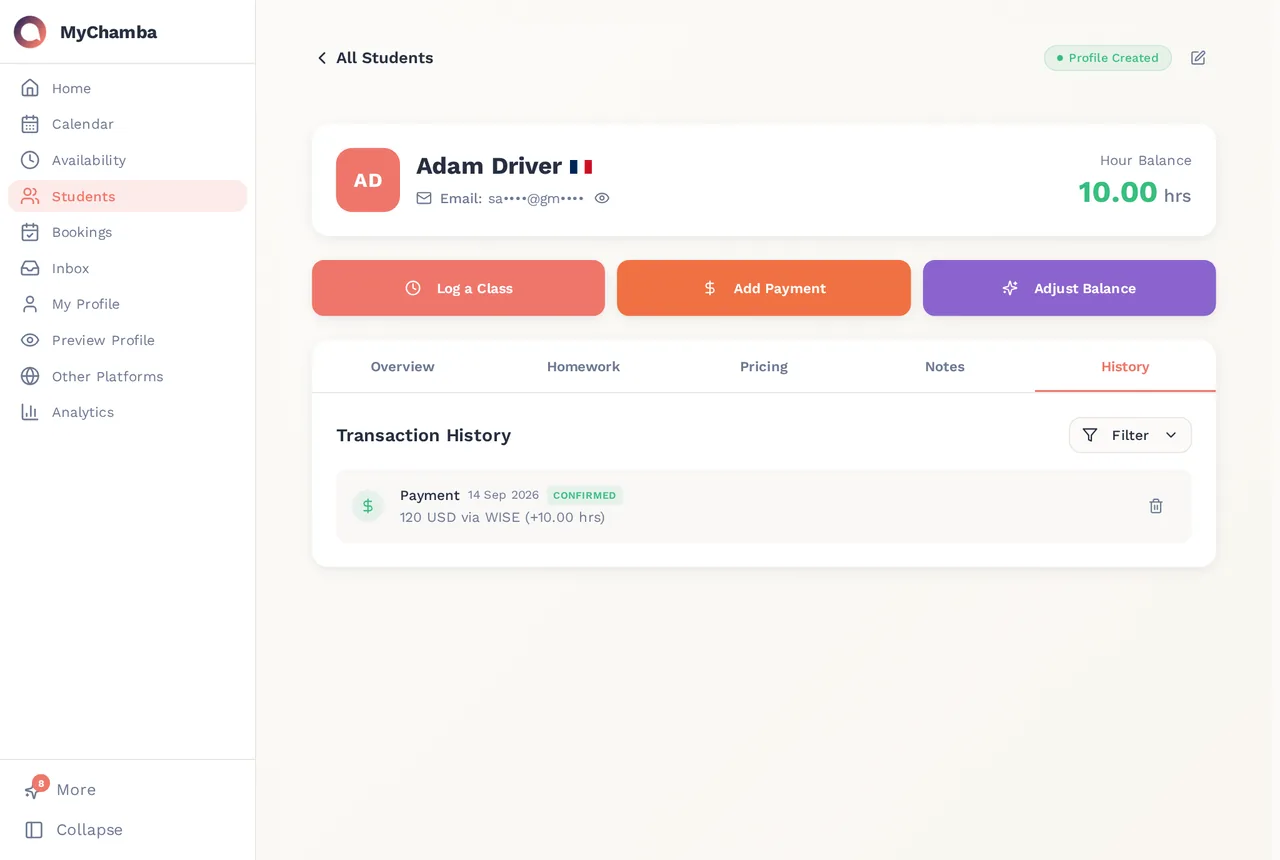
A balance is also honest in a way a list of payments is not. A student who has "paid recently" may be three lessons into the red; a student who owes you nothing may still have seven hours sitting there, which is a renewal conversation you do not need to have yet. Money-in and money-out tell you about your bank account. The balance tells you about the relationship.
For the balance to be worth anything, everything that moves it has to be written down the moment it happens: the class you taught, the class you cancelled, the payment that arrived, the half-hour you gave away because the connection died. Anything you fix later "from memory" is the thing that eventually produces a disagreement, and disagreements about money with someone you teach every week are expensive far beyond the amount involved.
One detail matters more than it sounds: a payment should be converted into hours at the rate that was in force on the day it covers, not at today's rate. If you raised your price in March and a student settles February's lessons in April, February was still charged at February's price — crediting that payment at March's rate quietly hands them fewer hours than they actually bought.
So keep your rates dated rather than overwriting them. It is what makes a late payment come out right, and it is what stops a price rise rewriting history for everybody who paid before it.
Taking payment like a professional, not a favour
- Say the terms once, at the beginning, in writing — what a lesson costs, what a block costs, when payment is due, how you want to receive it, and what happens if a class is cancelled late. Four sentences in the message where you confirm the first lesson. Almost everything awkward about tutoring money comes from terms that were never stated, being introduced later, when one of you is already annoyed.
- Make paying easy in the most literal sense. List the methods you accept and give each one a working link or the exact details — PayPal, Wise, Revolut, Payoneer, a local bank transfer, whatever already works for your students' country. A student who has to ask you how to pay will put it off, and you will feel the friction as a late payment even though it was really a missing link.
- Record every payment the same day, with the date it applies to, the amount and the method. It takes about fifteen seconds and it is what turns "I think Marta paid in March" into a line you can point at.
- That same record is the one you need later — a receipt for a student, an invoice for an employer, a year's income for a tax return. Written as you go, the work is already done instead of waiting for you in a folder of screenshots.
- Never add hours to a balance before the money has actually landed. A student telling you they have sent a transfer is a claim, not a receipt — usually an honest one, occasionally a mistaken one, and the international transfer that "went yesterday" can take four working days. Check, then credit. It costs you nothing and it keeps the one number you both rely on genuinely reliable.
Chasing a late payment without it being awkward
The reason chasing feels awful is that most tutors leave it until it is a confrontation. Three lessons have gone by, the amount has grown, and the message you finally send has to carry a month of accumulated resentment. Send it after one, while the number is small and nobody has done anything wrong yet, and it is not a confrontation at all — it is admin.
Talk about the balance rather than the debt. "You're down to your last half-hour — want me to send the details for the next ten?" does the whole job: it states the fact, it makes the next step obvious, and it never once calls anybody a late payer. Most people are not avoiding you. They meant to pay on Sunday, the week happened, and nobody reminded them.
Decide in advance what you do if it keeps happening, so you are choosing a policy rather than reacting to a person. Something like: a gentle note at zero, a firmer one at minus one hour, no new classes booked until the balance is positive. Then apply it the same way to everyone.
This is worth being slightly rigid about. The tutors who end up genuinely out of pocket are almost never the ones with strict rules — they are the ones who made an exception for somebody nice and then could not find a place to stop.
And build the check into a habit rather than relying on noticing. Once a week, look down your list of students and see who is at or below zero. That is a two-minute job when your records are in one place and an impossible one when they are spread across a spreadsheet, a bank app and your memory. No system chases people for you — but a system that shows you who is short, before the class is taught, is most of the problem solved.
Raising your prices without losing your students
Put your prices up once a year, on a date you choose, and tell people six to eight weeks before it happens. Almost all of the fear around price rises comes from doing it reactively, in a message that reads like an apology, to one student at a time.
A short, warm, unapologetic note — "from the first of March my rate goes to X; here is what that keeps buying you" — loses far fewer students than tutors expect, and the ones it loses are usually the ones costing you the most per hour anyway.
You do not have to move everyone at once. A common and entirely fair approach is that new students arrive on the new rate immediately, and existing students move at the start of their next block. It rewards loyalty visibly, it gives people a natural moment to buy one more package at the old price, and it means nobody's half-finished package changes value halfway through.
Whatever you do, do not rewrite the past. A price change should start on a date, with everything before that date staying exactly as it was charged. Overwriting a rate makes last month's payments recalculate into the wrong number of hours, and explaining that to a student is a far worse conversation than the price rise itself was ever going to be.
The system this actually needs
None of the above requires software. Plenty of tutors run it on a spreadsheet, and a spreadsheet you actually update beats any tool you do not.
What it does require is that three things live in one place per student: the rate they are on and when it started, every payment you have received, and every class you have taught — because the balance is only trustworthy if nothing moves it invisibly.
That is the job MyChamba does. Each student has a dated rate, payments you record turn into hours at the rate that applied on the day, booking a class takes the hours off and cancelling puts them back, and their page shows the balance and the full history behind it. The money itself still arrives however it already arrives — MyChamba does not process payments and never touches your students' cards. It just makes sure the one number you both rely on is right.
Further reading
- Wave (free invoicing software for freelancers)(opens in a new tab)
For the times a student or their employer needs a proper invoice or receipt, not just a MyChamba balance.
Related guides
- Set and change a student's rateHow rates work, how to change one, and why the start date matters.
- How hour balances workWhat moves the number on its own, how to move it yourself, and what negative balances allow.
- Record a paymentTurn money you have received into hours, and handle the requests students send you.
Run your tutoring from one place
MyChamba keeps your students, your schedule, your hours and your payments together — free for up to 5 students, and no commission on what you earn.
Create your free account