
How to plan a language lesson your student actually remembers
A lesson shape you can reuse every week, a course that goes somewhere, and homework that gets done — practical planning for independent language tutors.
The MyChamba Team · Published 14 September 2026 · 12 min read
Why a lesson that went well is forgotten by Thursday
You know the lesson. Your student talked for most of the hour, laughed twice, said "that was really useful" on the way out — and three weeks later they still cannot use the thing you spent that hour on. Nothing went wrong in the room. What went wrong is that the lesson was designed to be enjoyable and not designed to be remembered, and from the inside those two jobs look identical.
People retain what they had to produce, under a little pressure, more than once, with gaps in between. A lesson built as a chain of activities gives a student plenty of exposure and almost no retrieval: they recognise everything while you are sitting there and can generate none of it on Thursday.
The fix is not more material. It is the same material coming back at them on a schedule — the idea researchers call spaced repetition — in a form where they have to pull it out of their own head rather than read it off your screen.
So the useful planning question is not "what shall we do today". It is "what will my student be able to do by the end of the hour, and when is the next time they will have to do it again". Everything below is machinery for answering those two questions fast enough that you can do it for eight students a week without losing your evenings to it.
A lesson shape you can reuse every week
- Start with one outcome, written as a sentence your student could say about themselves. "I can describe my weekend using three past forms without stopping." "I can take a call from a supplier and politely ask them to repeat something." If you cannot write that sentence, you do not have a lesson yet — you have a pile of activities, and your student will feel the difference even if they never name it.
- Hang the hour on a shape you use every single time: five minutes of warm-up, ten of review, fifteen of new material, fifteen of guided practice, ten of free practice, five to close. The exact minutes matter far less than the fact that they are the same minutes next week — a student inside a familiar rhythm spends no attention working out what is happening and all of it on the language, and you stop planning from a blank page.
- Protect the review slot. It is the one everybody cuts when the clock is against them, and it is the one doing the retention work: ten minutes pulling back last week's point and the point from three weeks ago is worth more than any single new grammar item you could teach instead. Keep it oral and quick, and make them produce rather than recognise — not "do you remember the past tense?" but "tell me three things you did yesterday."
- Teach the new thing in one clear chunk, then drill it. Guided practice is where accuracy lives: you correct on the spot, you insist, you repeat until it is comfortable rather than merely understood.
- Leave free practice alone. Fluency lives there, and the rule is that you do not interrupt — write the errors down and bring two of them back at the close. Merge guided and free practice and you get students who are either hesitant and accurate or fluent and fossilised, depending on which half you accidentally chose.
- Close on purpose: two minutes, three moves. Ask them what they can now do that they could not at the start, set the homework out loud, and name what is coming next week — a student who knows where the course is going turns up differently. Shorter and longer classes scale the middle: a thirty-minute class keeps the warm-up, the review and the close, and carries one new thing instead of three.
Notice how they learn, without filing them into a type
You will hear a great deal about visual, auditory and kinaesthetic learners. It is worth knowing that the evidence for teaching to fixed learner types is thin: when researchers test it properly, matching a lesson to a student's declared style does not reliably improve what they retain. Deciding in week two that somebody "is a visual learner" mostly narrows what you ever offer them.
What is true is smaller and far more useful: the same lesson lands differently on different people. One student meets a new tense twice and starts using it; another needs to see it written, drill it on paper and meet it again next week before it is theirs. One learns most from a recording of two people arguing about football; another freezes without the transcript. That is about this person, this topic, this month — not a permanent category.
So notice, adapt, and write down what you noticed. If a fortnight of listening tasks produces nothing and one written drill produces a breakthrough, give that student more written drilling — and come back to listening later, because the point is never to let a weak skill stay weak. A tutor who adjusts the mix for the person in front of them teaches better than one who runs every lesson identically, and that is the entire claim. It does not require typing anybody.
Plan a course, not a string of lessons
A run of individually good lessons is not a course. It is a playlist, and students can feel it — they enjoy every session and cannot tell you what they are getting better at. Plan in blocks of eight to twelve lessons instead, roughly a term and roughly the length of most people's patience, and start from the end. Where should this person be when the block finishes, said in the same "I can…" language you use for a single lesson?
Then run two or three threads through the block rather than one. Most courses want a structural spine — the tenses, the cases, the particles, whatever the language makes you climb — plus a topic thread that comes from the student's actual life, plus one skill they are quietly bad at and avoid. Each lesson touches the spine and one of the others.
Here is one, concretely. Diego manages a hotel in Cartagena, sits at about B1 in English, and needs to handle calls from suppliers. The spine is the tense pair he keeps falling out of, past simple against present perfect. The topic thread is his own week: booking changes, complaints, prices, apologies. The skill he avoids is listening without a face to read, so every third lesson ends with ninety seconds of audio played once, at full speed, no transcript. Twelve lessons, three threads, one sheet of paper — and it takes ten minutes to sketch.
Leave slack deliberately: one lesson in four with nothing planned in it. Somebody will arrive with a job interview on Thursday, a wedding speech, an email they do not understand, and that lesson will be worth more to them than anything you had prepared. If the slack is in the plan you can spend it without feeling behind, and if nobody needs it you have a free review lesson, which no course in history has suffered from.
Finish the block with a checkpoint — a lesson openly about what they can now do that they could not twelve weeks ago. It is good teaching, because it forces retrieval one last time. It is also good business, because it is the natural moment to talk about what the next block is for. A student who has just heard themselves do the thing they came to do is not a student you have to persuade.
Setting homework that actually gets done
Homework fails for three reasons and all three are yours to fix: it was too big, it was too vague, or nobody ever looked at it. "Practise the past tense" manages all three at once. An adult with a job reads that, feels mildly guilty, and does nothing — not out of laziness, but because there is no obvious first move and no visible consequence.
Make it small and almost rudely specific. Ten to twenty minutes, one task, a clear finish line. "Write five sentences about your weekend using the three past forms we practised, and send them to me before Sunday night." "Listen to this four-minute clip twice and note three words you did not know." "Record yourself reading this paragraph and send me the audio." A student can decide to do a task like that on a bus. Nobody can decide to do "practise the past tense" anywhere.
Keep the resource with the task. A worksheet linked in a chat thread three weeks ago is a link nobody opens, and every extra step between intention and starting costs you completion. The instruction, the video, the document and the due date belong in one place the student can open in one tap — and that place should not be your memory or their inbox.
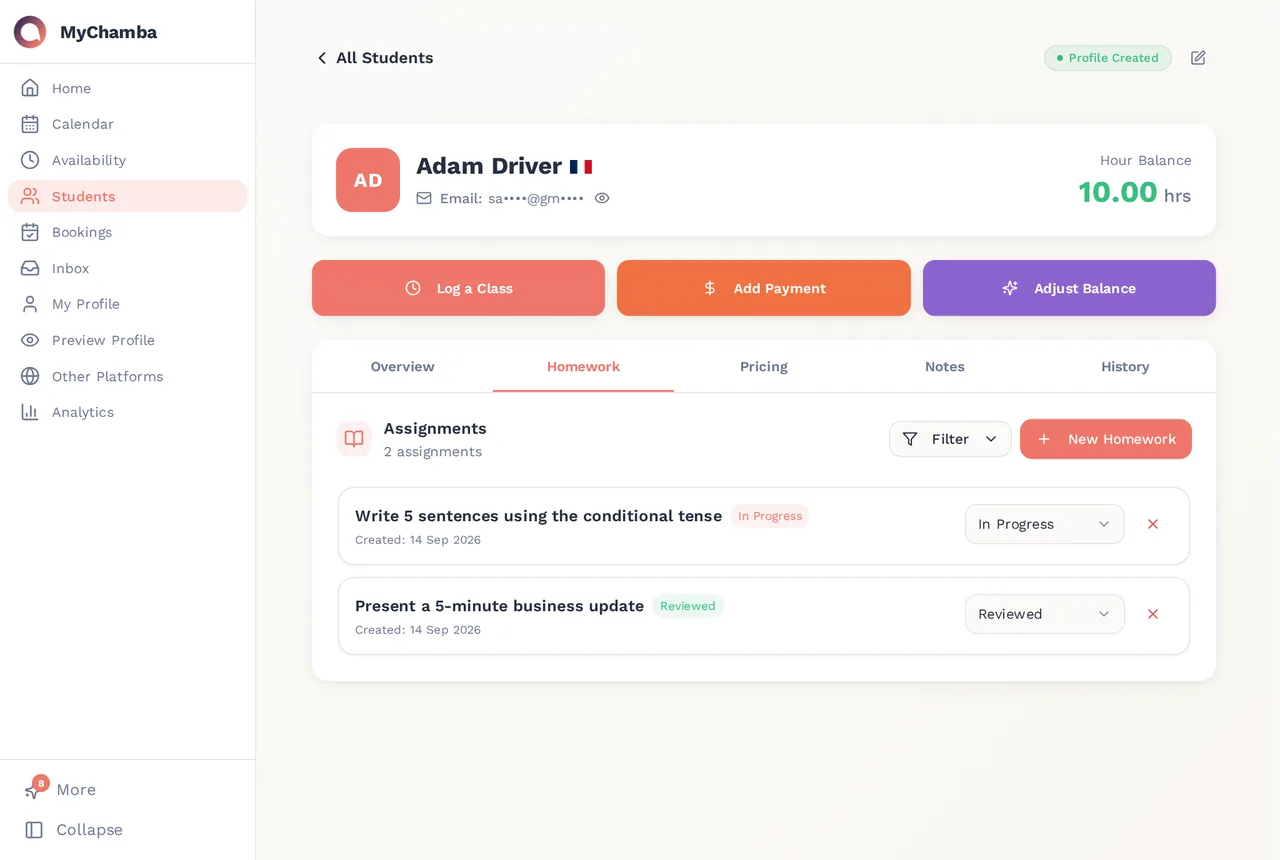
Give each task a state rather than trusting your memory. Not started, in progress, submitted, reviewed — four labels are enough, and a glance down a list of them tells you who is ahead, who is stuck, and who quietly stopped doing anything a month ago and has been carried since by being charming in class. That last student is the one you would otherwise notice in month four, when they cancel. Here is what that looks like on a student's page in MyChamba:
Then open it in the next lesson, in the first ten minutes, every time. This is the whole trick. Homework that gets mentioned again gets done; homework that is never mentioned again teaches the student, quite correctly, that it was optional. You do not have to be strict about it. "Show me what you wrote" is enough, and it doubles as your review slot.
Tools worth trying, and what each one is actually for
- A spaced-repetition flashcard app — Anki if your student likes control, Quizlet if they want something friendlier — for the vocabulary and set phrases that only stick through repeated retrieval. Build the deck together from words that came up in your lessons; a deck the student never helped make is a deck nobody opens.
- One shared document per student, holding the week's target sentences, the corrections you made and the links you sent. A single live page beats a trail of attachments, and neither of you ends up searching a chat thread for the worksheet from three weeks ago.
- A voice recorder, used in both directions. Ask for thirty seconds of them reading what they wrote, and send thirty seconds back with the corrected version — pronunciation feedback is almost impossible in writing and takes two minutes in audio.
- A subtitled video source your student would watch anyway: a series, a news channel, somebody funny on YouTube who speaks your language. Real speech at real speed, with subtitles as the safety net, does more for listening than any exercise you could design.
- A timer, which is the cheapest tool on this list. It is what stops the warm-up eating the review slot, and what stops free practice quietly becoming a conversation you dominate. Whatever else you use, remember the tool is not the plan — it only ever carries one part of it.
Keeping track, and where to start this week
Two lines after every lesson, written while the call window is still open: what we covered, what to pick up next. Thirty seconds. This is the highest-return habit in tutoring and almost nobody does it, because it feels unnecessary at the end of a lesson you remember perfectly and turns out to be essential at the start of the next one, eight students later.
Keep those lines per student rather than in one running notebook, and split them into what the student can see and what is only for you. "Struggles with articles, stop correcting every one, it is shutting her down" is a note you need and she does not. "We finished the conditional, next week is reported speech" is one she will be glad to read between lessons. Both are useful; only one is shareable.
Before a lesson where you feel stuck with someone, read your last four notes about them instead of planning something new. The reason a student has plateaued is almost always written down already: the same error recurring, the same topic avoided, the skill you have quietly stopped practising because they dislike it. The notes are a lot cheaper than the insight you were going to have in the shower.
So do not redesign your whole practice on a Sunday. Pick one student — ideally the one you feel vaguely guilty about — and write the outcome sentence for their next lesson. Then run the shape once, keeping the review slot even when it feels indulgent. One lesson is enough to feel the difference between a plan and a list.
After that, do the block. Twelve lessons on one sheet of paper, three threads, one lesson in four left empty, a checkpoint at the end. It takes less time than planning two lessons properly, and it removes the blank page from every Sunday for the next three months.
The rest is simply keeping the record somewhere that is not your head. MyChamba gives every student a page of their own — lesson notes you can keep private or share with them, homework that carries a status and its own resource links, and the history of everything you have taught them — so the two lines you write after Tuesday's class are waiting for you at the start of next Tuesday's. That is the whole system: a shape, a block, and a record.
Further reading
- Anki (free spaced-repetition flashcard app)(opens in a new tab)
Build a shared deck from the words that actually came up in your lessons, not a generic list.
- Quizlet (spaced-repetition flashcard app)(opens in a new tab)
The friendlier alternative to Anki if a student wants less control and a simpler interface.
- CEFR self-assessment grid (Council of Europe)(opens in a new tab)
The official source for the levels and "I can…" statements this article's lesson planning is built around.
Related guides
- Set and mark homeworkCreate an assignment, attach resources, and follow it through to reviewed.
- Log, change and cancel classesPut a class on the calendar, read the warnings, and know what each change does to the balance.
- Inside a student's profileThe header, the five tabs, the three buttons, and what external students do not get.
Run your tutoring from one place
MyChamba keeps your students, your schedule, your hours and your payments together — free for up to 5 students, and no commission on what you earn.
Create your free account